NRC1300 BOPP Adhesive Tape Manufacturing Machine: Specifications, Line Layout and Buying Guide
What the NRC1300 adhesive tape manufacturing machine actually does
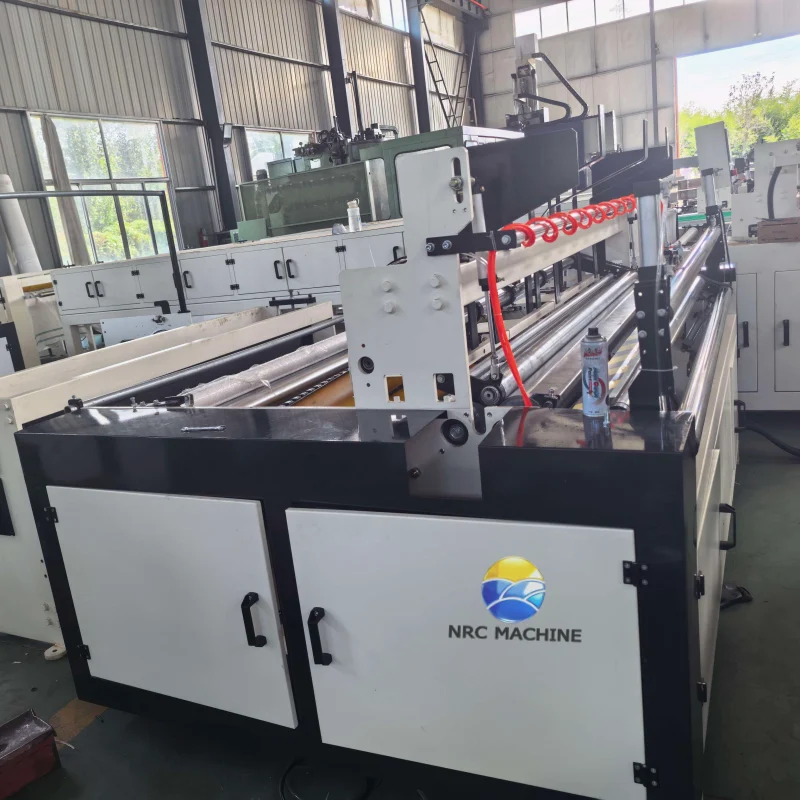
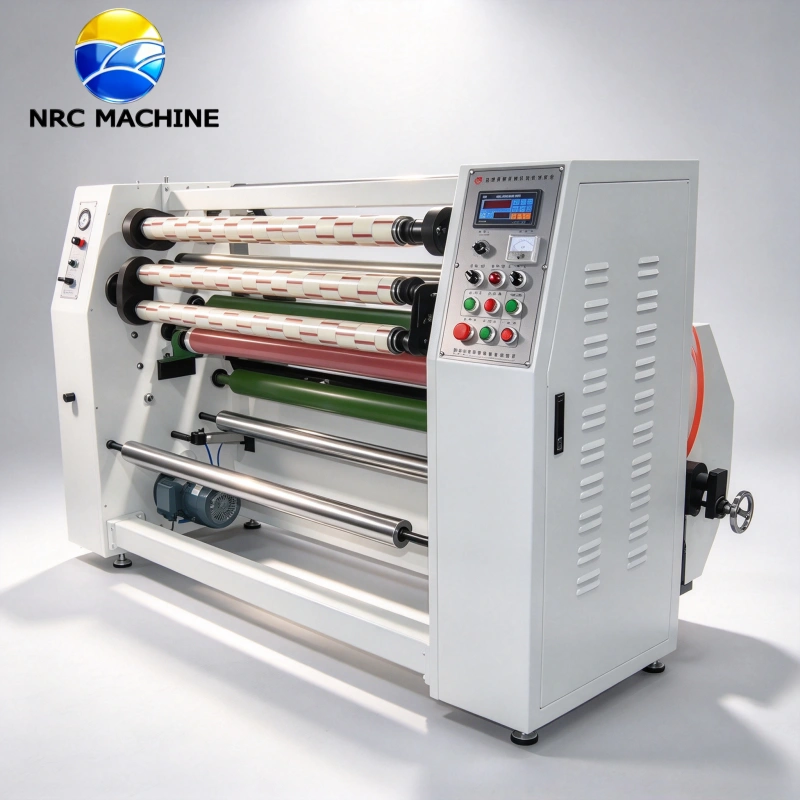
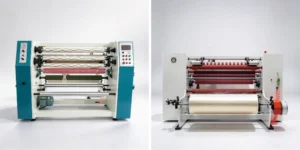
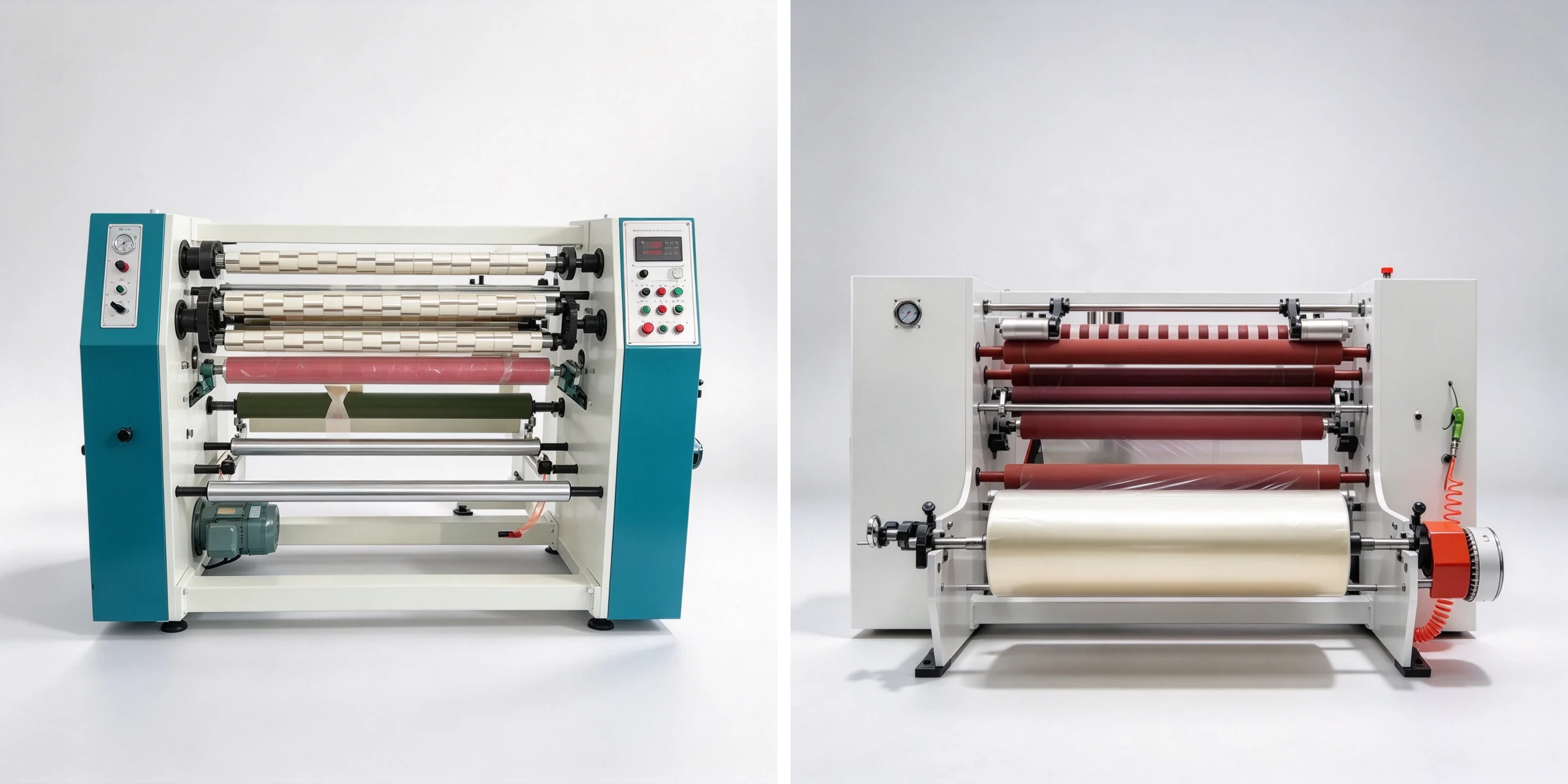
The NRC1300 is a 1,300 mm BOPP adhesive tape manufacturing machine for converters who buy coated jumbo rolls and sell finished retail rolls. It slits a master roll into lanes as narrow as 10 mm and rewinds each lane into a finished roll at 0–180 m/min.
Three auxiliary units — a tape core loader, a paper core cutting machine and a rework rewinder — complete the line. This page documents what each unit does, the verified specifications, the production sequence and the data we need in order to quote.
One point is worth stating first, because it decides whether this machine is the right purchase. The NRC1300 does not coat adhesive. It takes an already coated and dried jumbo roll and converts it into saleable rolls. A converter who owns a coating line, or who buys coated jumbo stock from a film plant, adds this unit to finish the product. Coating and slitting are separate capital items, and quotations for the two are not comparable.
From jumbo roll to retail roll: the converting sequence
A transparent tape is a film-based pressure-sensitive product. The base film is biaxially oriented polypropylene (BOPP), occasionally PET. One face is corona treated so that surface energy rises and the adhesive wets the film evenly instead of crawling. An acrylic emulsion — a pressure-sensitive adhesive with butyl acrylate as its main monomer — is coated on, then dried. The category dates to 1928, when Richard Drew produced the first cellulose tape; the process logic has barely changed since.
The NRC1300 handles the final three moves:
- Slitting. The 1,300 mm web is split into parallel lanes by a gang of circular blades, each lane set to a customer width.
- Rewinding. Each lane is wound onto a paper core to a counted length, with tension held constant so the roll does not telescope or wrinkle.
- Doffing and packing. Finished logs come off the shafts, are sampled for tack and thickness, and go to labelling or shrink wrap.
Why buyers also call it an adhesive tape slitting rewinding machine
The names are interchangeable, and the search terms vary by market. “Slitting” describes the cutting action; “rewinding” describes building the finished roll on a core. Suppliers and buyers use cortadora rebobinadora de cinta adhesiva, adhesive tape slitting and rewinding machine, adhesive tape making machine and tape slitting machine for the same unit. If a quotation you receive uses one of these names, check the working width and the minimum slit width — those two numbers, not the label, define what the machine can produce.
Line composition: four units of one adhesive tape manufacturing machine
The line is modular. A start-up workshop can begin with the slitter and add the core handling units as volume grows; a plant that already cuts cores in-house may only need the slitter and the rework rewinder. Each unit below is quoted separately.
Unit 1 — 1300 adhesive tape slitting and rewinding machine
This is the core of the line. The 1,300 mm working width sets the largest jumbo roll it accepts, and the 10 mm minimum slit width sets the narrowest product. Dual-shaft winding lets one shaft wind while the other is being doffed, so the machine does not sit idle between batches. Tension is set per lane, and a length counter stops each roll at the ordered metreage. Blades are changed as a set, which keeps lane widths identical across the web.
Unit 2 — Tape core loading machine
A 5.6 m loading table that presents paper cores to the winding shafts at the correct height and spacing. It accepts cores with an inner diameter from 25.4 mm to 76.2 mm. Manual core loading is the slowest step on a slitter; automating it is the difference between a machine that runs at its rated speed in short bursts and one that sustains it across a shift.
Unit 3 — Paper core cutting machine
Cuts purchased paper cores down to the exact widths the slitter is running, with width set by mould rather than by operator judgment. It handles cores with a 76.2 mm inner diameter. Cutting cores in-house means one core SKU in stock instead of a shelf of pre-cut sizes, and it removes the mismatch that appears when a supplier ships cores 1–2 mm off the ordered width.
Unit 4 — Rewinding machine for non-conforming stock
A compact rework unit for rolls rejected at inspection: telescoped, contaminated, short-counted or with a damaged outer layer. It rewinds to a maximum wound diameter of 200 mm at 0–100 m/min, stripping the defective layers and re-counting the length. Material that would otherwise be scrapped returns to saleable stock, which matters most in the first months of operation when operator technique is still settling.
Technical specifications
Figures below are the manufacturer’s standard configuration. Where a buyer’s product mix requires a change, it is quoted as a variant rather than assumed.
Main machine: NRC1300 slitting rewinder
Parámetro | Especificación |
Modelo | NRC1300 |
Maximum width of jumbo roll | 1.3 m (1,300 mm) |
Minimum slicing width | 10 mm |
Cutting (slitting) speed | 0–180 m/min, variable |
Machine dimensions (L × W × H) | 2.45 m × 1.6 m × 1.35 m |
Tensión | 380 V, 50 Hz |
Slitting method | Gang circular blades, width set per lane |
Bobinado | Dual-shaft, tension controlled, length counter |
Auxiliary equipment
Equipamiento | Dimensiones (L × An × Al) | Key parameter |
1300 tape core loading machine | 5.6 m × 0.8 m × 1.35 m | Paper tube diameter 25.4–76.2 mm |
Paper core cutting machine | 1.5 m × 0.6 m × 1.15 m | Cutting width mould controlled; paper tube inner diameter 76.2 mm |
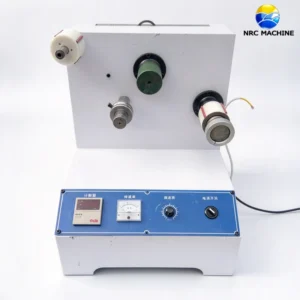
Rewinding machine (rework) | 0.5 m × 0.62 m × 0.45 m | Maximum curl diameter 200 mm; winding speed 0–100 m/min |
Note on power. 380 V / 50 Hz is the standard supply for this configuration. Confirm your site supply, phase and breaker capacity before the order is placed; export builds for other supply voltages are quoted per project, not converted from the standard sheet.
How the line runs: production flow, start to finish
A shift on the NRC1300 follows the same ten steps every time. Skipping step 1 or step 9 is where most yield loss begins.
- Inspect the jumbo roll. Check width, coating weight, edge condition and core integrity. A damaged master roll produces bad lanes across its whole width.
- Mount and align. Load the roll on the unwind shaft and centre it so that lane edges do not drift as the diameter drops.
- Set the blade gang. Install blades for the ordered widths. Confirm each lane against the width list before threading.
- Thread and tension. Route the web through the tension zone, set per-lane tension, and check for web wander at low speed.
- Load cores. Position cores on both winding shafts, using the core loader where fitted.
- Ramp up. Start below 30 m/min, watch for telescoping, then increase toward the 180 m/min ceiling as the roll builds.
- Wind to count. The length counter stops the shaft at the ordered metreage. Short rolls and over-runs both show up as customer claims.
- Doff and transfer. Change over to the second shaft, unload the finished logs, and keep the first shaft winding.
- Sample and test. Check initial tack, adhesive thickness, slit edge quality and length accuracy on the first roll of each batch.
- Pack. Label by width and length, then shrink wrap or carton. Record the batch so a claim can be traced to a master roll.
As an illustration of cycle time: at 180 m/min, a 100 m retail roll is wound in roughly 33 seconds per lane. Real shift output is lower, because doffing, blade changes and roll changes take time — which is why the dual-shaft arrangement and the core loader matter more than the top speed figure alone.
Who this adhesive tape manufacturing machine fits
The NRC1300 is sized for operations that sell tape in cartons and pallets, not for plants running two-metre webs around the clock. It suits four buyer profiles:
- Start-up tape plants buying coated jumbo rolls and building a first product line around 1,300 mm stock.
- Small and home-based workshops converting for local packaging distributors, where a compact footprint and single-operator running matter more than tonnage.
- Packaging distributors who want to cut their own widths and lengths instead of holding a dozen imported SKUs.
- Existing coaters adding finishing capacity without buying a second coating line.
It is not the right choice for coating, for webs wider than 1,300 mm, or for specialty constructions that need dedicated tension profiles — masking tape with rubber adhesive, foam tape or double-sided film — where the unwind and winding behaviour differs enough to require a different machine design. Tell us the product type in the first message; if the NRC1300 is the wrong fit, saying so early saves both sides a quotation cycle.
Quality control: where tape grade is decided
Retail tape is judged on four properties, and the slitter influences three of them.
Property | Typical reference | What the line controls |
Initial tack | Rolling-ball tack, grade 13 or higher (e.g. PSTC-6 / GB/T 4852 method) | Nothing directly — set by the adhesive. The line preserves it by avoiding heat and tension damage to the coating. |
Adhesive thickness | Approximately 22 µm | Blade clearance and web tension; a wandering web smears the coating at the lane edges. |
Roll geometry | No telescoping, no creases, square ends | Tension control per lane and shaft alignment, plus core width matched to lane width. |
Length accuracy | Ordered metreage ± tolerance agreed with the buyer | Length counter and consistent slip between shaft and core. |
In practice most rejected stock traces back to three causes: a core 1–2 mm off width, tension set too high for a thin film, and blades left in service past their edge life. The paper core cutting machine removes the first cause at source; the other two are operator discipline, which is why commissioning includes hands-on training on the buyer’s own material.
Site, power and staffing requirements
Plan the floor around the slitter, not around the auxiliary units. The main machine occupies 2.45 m × 1.6 m with a 1.35 m height; the core loader runs 5.6 m and is normally set parallel to the winder rather than in line with it, so it does not extend the production length.
- Power. 380 V / 50 Hz standard. Confirm phase and breaker capacity with your electrician before delivery; the machine must not be connected to a supply that differs from the nameplate.
- Floor. Level, load-bearing concrete. Leave access on the blade side for blade changes and on the doff side for roll trolleys.
- Staffing. One trained operator per machine is typical. A second person helps at the doff end once running speed is sustained above roughly 100 m/min.
- Consumables to stock. Circular blades, paper cores, shrink film or cartons, and a tack-test setup for incoming and outgoing checks.
- Maintenance. Daily check of blade condition and web path; weekly cleaning of tension rollers and shaft surfaces; blade replacement as a matched set, not one at a time.
What to send us for an accurate quotation
Quotations become unreliable when a specification is guessed. Send these eight points and the reply will be a configuration, not an estimate.
- Jumbo roll width and maximum roll diameter you can source.
- Base film: BOPP, PET, or both.
- Tape thickness (total, including adhesive) in µm.
- The full list of slit widths you intend to sell, with monthly volume for each.
- Paper core inner diameter (25.4 mm, 38 mm, 76.2 mm or other).
- Finished roll length per SKU.
- Site supply voltage, frequency and phase.
- Destination port and required delivery window.
With those eight items, the configuration, the accessory list and the shipping volume can be fixed in one exchange. Without them, any price given is provisional.
Frequently asked questions
Q1:What does an adhesive tape manufacturing machine do?
A1:It converts a wide, coated jumbo roll into finished rolls of saleable width and length: the web is slit into lanes, each lane is rewound onto a paper core to a counted length, and the rolls are packed. On the NRC1300 line this is done at up to 180 m/min across a 1,300 mm working width.
Q2:Is this a coating line or a converting line?
A2:One converting line. The NRC1300 slits and rewinds film that is already coated and dried. Coating — corona treatment, adhesive application, drying and lamination — is a separate machine and a separate budget. Buyers who already hold coated jumbo stock need only the converting line.
Q3:How wide a jumbo roll can it take, and how narrow can the tape be?
A3:Up to 1,300 mm wide, down to a 10 mm slit width. Those two figures define the product range: a 1,300 mm master roll can be split into one 1,300 mm lane or up to 130 lanes at the minimum width, subject to blade set-up and core availability.
Q4:What tape thicknesses can it run?
A4:Standard BOPP packaging tape in the 35–50 µm range runs without special setup. Thinner films need lower tension and more careful blade clearance, and should be stated at quotation so the tension configuration is set for them rather than adjusted after delivery.
Q5:How many cores does the line support?
A5:The core loader handles inner diameters from 25.4 mm to 76.2 mm. The core cutter is set up for a 76.2 mm inner diameter and cuts to mould-controlled widths, so one core SKU can serve several tape widths.